|
November 2-5, 2006
Open invitation expedition; People returning from March 2006 Nor Cal expedition
pay no fee.
To sign up for this expedition see the BFRO Expedition
FAQ.
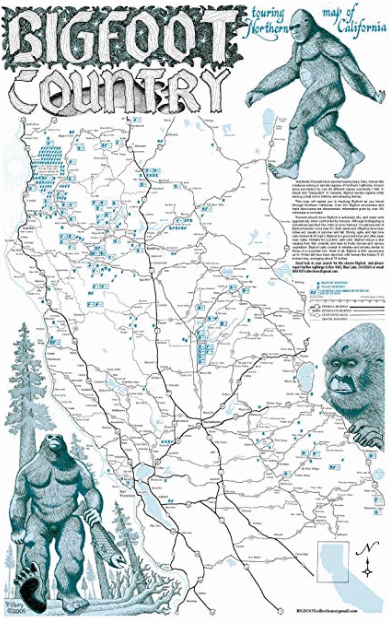
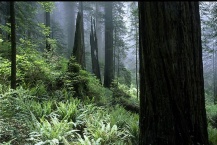
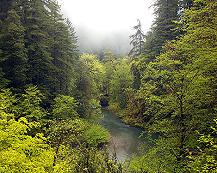
Northern California is the epicenter of bigfoot country. The region
has the highest density of historical sightings and track finds.
It is also where the Patterson footage was obtained.
On prior BFRO expeditions in Nor Cal rainforests we operated at
night, assuming that our luring techniques would only get
responses after dark. They usually did yield results at night, after
checking enough valleys, but the darkness always prevented us from
getting any daylight footage.
On the last expedition in March 2006 we had no choice but to try
some things in daylight. The heavy winds and torrential rains in
the evenings made it impossible to hear the sounds that we needed
to listen for. When we had breaks in the weather during the day
we sent out groups into some of the valleys we had previously identified
for night-ops.
The first group to head out on the first morning was a father with
three teenage sons. They were all strong hikers and covered a lot
of ground quickly. After a long hike, just before they reached their
vehicle, the last boy in the pack asked his brothers if either of
them had thrown a rock at him. He said a rock hit the ground behind
him and skipped into the brush. He assumed one of his brothers had
thrown it. They all said they had not thrown anything. The boy said
the rock seemed to come from the side of the trail, apparently from
the trees. This happened in broad daylight.
The father of the boys mentioned this to us at breakfast the next
day. His comment raised some eyebrows and we asked him to repeat
what he said. He described the incident again and we immediately
pulled the boys aside and grilled them a bit.
It was clear they were being honest. The only issue was one of interpretation.
The boy who had the observation was adamant that it was a rock thrown
laterally, and not something that had fallen out of a tree. He was
very familiar with thrown rocks, because back home he and his brothers, like
most boys their age, often threw rocks. Because of that he felt strongly that
he was qualified to make the call. We eventually agreed. All of
them, including the father were certain that the specific spot had
no rock faces or steep slopes nearby, from which a rock could have
fallen and ricocheted sideways. For those who were able to question the boys, there was no other obvious explanation.
 |
We decided to direct our best equipped participants to that valley
as soon as the rain stopped. Luckily the valley was conducive to
unseen, quiet entry. This allowed us to attempt some luring protocols
from hidden positions in the daylight. We went in to the general
area where the rock had been thrown. We settled in for 20 minutes
or so, until the normal animal activity sounds (birds, etc.) resumed.
Then we slowly began with some sounds. We waited and listenned,
then repeated and raised the volume until the sounds echoed through
the valley. Within 15 minutes one person was reporting "home
run" knocks from a ridge above. The sounds were intermittent
but moving down the slope. Other people were directed by radio to
his position and confirmed the sounds of movement on the hillside.
The people with the best camcorders were asked by radio if they could
move toward the sounds on the hillside. They agreed to try for it, and
moved in, but it didn't take long before they radioed back and said it
was a bad idea. The rainforest brush was nearly impenetrable, and the
noise they were making while trying to penetrate it was apparently alerting
the animals they were pursuing, which seemed to be moving back up the
slope.
We directed everyone to come off the hillside and move back into concealed
positions, so we could try more of the sounds that had brought them around
in the first place. It didn't work the second time around. We waited and
tried, and tried some more, but nothing responded.
It was getting dark and it was starting to rain again, so we asked people
to move out in small groups.The plan was to return in few hours, after
the rain band passed, to see what would happen at night in that same valley.
People exited the area in small groups and made their way back to the
road, not far from the base camp. Four of those people heard loud "home
run" knocks from the hill overlooking the trailhead as they exited.
We prepared for another forray after dark, but the winds kicked up and
were strong. The park ranger who was with us strongly discouraged us from
walking among the big trees while gale force winds were blowing. The titanic
branches that fall off the giant redwoods during high winds are large
enough to flatten a car. So we backed out and headed back to camp. We
radioed in a request for a thermal camera to monitor the area around the
base camp that night.
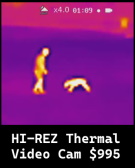
As the roof-mounted-thermal-camera-vehicle entered the camp, the driver
(Steve Willis) saw the thermal image of a very tall figure moving toward
the camp, from the direction of the trailhead where the knocks were heard
earlier. The figure stopped, looked across the base camp, then quickly
walked back into the trees. Steve attemped to hook up his comcorder to
the system before the figure was out of view but it was too late.
Getting to the stage where these types of opportunities will arise, has
been a progressive learning process. We've learned valuable lessons each
time we've pursued these animals. We've seen clearly and repeatedly that
certain things will elicit responses and approaches, but these animals
won't fall for the same tricks twice. In Northern California compelling
things will happen when we're in a new area for the very first time. We
have to find a new zone every time we need to trick some of these animals
into approaching us, so we can try new things when they do approach.
Luckily, in regions like coastal Northern California, there is so much
rich, rainforest habitat, we can usually find another habitation zone
as little as five miles away from an area that yielded results before.
Because of what happened in March of 2006 in Northern California, we
are very eager to try some daylight camera strategies in November. You
are invited to attend if you are interested in participating or seeing
this for yourself.
If you attended the March 2006 expedition you are cordially invited (for
no fee) to the November trip. The storm that bedeviled us during that
expedition was the worst storm of the entire season. It is very, very
unlikely that the weather in the first week of November will be
as bad as it was during that trip. It will very likely to be much better
weather.
See Also:
The Robb Report article about
the March 2005
Expedition in the California Redwoods.
Comment about the May
2005 Expedition in the California Redwoods.
If you are interested in attending this expedition, please see the
Frequently Asked Questions page.
|