|
Fees and Conditions
The fee to attend a BFRO expedition:
FIRST-TIME PARTICIPANTS:
- $300 (US funds) for first-time participants ("newbies").
The organizer has the discretion to allow a paying participant the option
to bring one immediate family member (wife, brother, father, mother, son,
etc.) for no additional fee. Additional family members or friends may
accompany the participant for an additional $100 (US funds) per person. These two
fee exceptions only apply to people riding in the same vehicle. Hence,
if another vehicle is involved (taking up some of the limited space at
a camp) then the driver of each vehicle must pay the full fee, regardless
of the relationship. The given organizer has the discretion to make exceptions
regarding additional vehicles in situations where parking space is less
of an issue.
REPEATER FEE
- $100 (US funds) per person for participants who have
attended a previous BFRO expedition, and who are very willing to help
the organizer around camp whenever requested.
The organizer has the discretion to allow a
repeater the option to bring one immediate family member (wife, brother,
father, mother, son, etc.) for no additional fee. Additional family members
or friends may accompany the participant for an additional $100 (US funds) per person.
These two fee exceptions only apply to people riding in the same vehicle.
Hence, if another vehicle is involved (taking up some of the limited space
at a camp) then the driver of each vehicle must pay the full fee, regardless
of the relationship. The given organizer has the discretion to make exceptions
regarding additional vehicles in situations where parking space is less
of an issue.
INVESTIGATOR FEE
- Active BFRO Investigators may attend for free, and may bring one
campanion for free. Additional companions or relatives must pay $100 (US funds) each.
"Active BFRO Investigators" are the ones who investigate and post reports
to the BFRO web site on a regular basis, and have been doing so for at
least six months.
The conditions for participating in a BFRO expedition :
1) Prior to the expedition you must be able to: a) send and receive email
when necessary, b) periodically check a private message board, and c)
make sure you have a cellphone with voicemail that has been set up to
receive messages at any time.
2) You must have camping gear and clothing
for any weather conditions that may arise during the expedition.
3) You must bring your own food, drinks, and water.
4) You must provide your own transportation.
5) For safety reasons, you must be able to walk at least three (3) miles
on tricky trails without assistance.
BFRO expeditons are organized, but not catered. The registration fee compensates
the organizer for his/her efforts in planning the expedition, and registering
the participants, and pre-scouting the target areas, and various other
tasks, responsibilities, and arrangements. It takes a lot of time to do
this all properly.
The fee also helps the BFRO regulate the demand for open slots on expeditions,
while ensuring that only those people with
a serious interest in the subject will attend.
_____________________________________
Restrictions
Age Limits
21 is the general age limit for people attending alone, or
without someone 21 or over.
The 21 age limit does not apply to:
- People accompanied by someone over the age of 21.
- Current military personnel.
- Former military personnel (honorably discharged).
- Currently enrolled, full-time college or university students.
- College or university graduates with verifiable degrees.
- Currently employed first-responders (fire, police, EMT, etc.)
Attendees are discouraged from bringing small children. If a spouse is content
to remain at base camp with a small child, that will not be a problem. The
problem occurs with slightly older children who may want to go into the
woods with us. They may not be allowed to go with the adults at night. Noisy
or rambunctious children will not be allowed to go anywhere with us, day
or night.
Pets
No pets are allowed, especially dogs.
Weapons
Guns are not allowed. You may carry a knife, a machette, a spear, pepper spray, etc., but not a gun.
There are no modern reports of sasquatches attacking humans. They will
sometimes approach and intimidate human intruders at night, but not attack
them. You are not putting yourself at risk by not carrying a gun,
but you are potentially putting everyone else at risk if you are
carrying a gun.
_____________________________________
Registration Process, Etc.
There is a contact person for each separate expedition -- the organizer.
You must send an email to the organizer for the expedition you are interested
in. In the email you should ask to be contacted by phone at your number.
In the subject line of your email, please write the name of the expediton,
such as "Michigan Expedition".
In the body of the message write:
1) your name
2) your phone number
3) the name of the expedition(s) you are interested in
4) please mention that you have read the conditions (listed below) and
that you are aware of the fee.
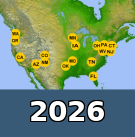
Here are the email addresses for expeditions currently open for registration
:
For MINNESOTA send
an email to Andy Pieper at Minnesota@BFRO.net
For ONTARIO send an email to Todd Prescott at Ontario@BFRO.net
For UTAH send an email to Caroline Curtis at Utah@BFRO.net
For MANITOBA send an email to Blaine McMillan at Manitoba@BFRO.net
For ALBERTA send an email
to Darcy Stoffregen at Alberta@BFRO.net
For WYOMING send an
email to Brooke Raser at Wyoming@BFRO.net
For COLORADO send an email to Dennis Pfohl at Colorado@BFRO.net
For VANCOUVER ISLAND (SOUTH) send an email
to Cindy Dosen at Vanc_Isle_South@BFRO.net
For WASHINGTON OLYMPIC PENINSULA send an email to Kristine Walls at Washington@BFRO.net
For PENNSYLVANIA send an
email to Paul Mateja at Pennsylvania@BFRO.net
For WASHINGTON CASCADES send
an email to Kevin Jones at Washington@BFRO.net
For NORTHERN CALIFORNIA
send an email to Brandon Kiel at NCalifornia@BFRO.net
For VANCOUVER ISLAND (NORTH) send an email to Blanine
McMillan at Vanc_Isle_North@BFRO.net
For NEW YORK send an email
to Nick Maione at New_York@BFRO.net
For BC INTERIOR send
an email to Darcy Stoffregen at BC_Interior@BFRO.net
For MISSOURI send an email to Ron Boles at Missouri@BFRO.net
We select territories that have a history of reports.
The reports you see posted on the web site are only a fraction of the
information we have. They are only the first hand reports, and
the ones that witnesses have allowed us to post publicly on the
web site. There is a lot more information for a given state than what
you see on the web site, including lots of Class C information -- rumors
and hearsay -- which have proven to be helpful on several occasions.
The trips are scientific in nature, but you will
only understand where these efforts fall in the scientific process once
you have experienced it for yourself. No other scientific efforts will
happen with respect to these animals unless these expeditions happen first,
because the BFRO is figuring out how these animals can be studied.
"Proof" is always one of the goals of an expedition, but "proof"
is a subjective idea. Proof is whatever will satisfy a given "standard
of proof". If you see a sasquatch yourself, that will be "proof"
to you, but not to anyone else. If you get a video, that will be "proof"
to a lot more people, but not to everyone. A dead body might be proof
to nearly everyone, but we're trying to learn the behavior of the
living animals on these expeditions, not trying to bring back a body.
You will have tremendous respect for these animals once you've been approached
by one. You will respect their intelligence, and their right to be, no
matter how scientific you think you are.
Back to the registration process ...
Once the payment is received, you will be contacted again and added to
a private, password-protected message board wherein important information
awaits you, including the location where to meet, the names and bios of
the other attendees, the basic game plan for that expedition, etc. On
the message board you will be able to ask questions and get phone numbers
of other participants.
These trips do not get cancelled due to weather. We go to hot zones in
the winter, and cold zones in the summer, to minimize the interference
of weather.
You should reserve a space on an expedition far in advance if you know
you want to go. These trips can fill up fast if. Some people wait til
the last minute to register, and the trip is already full. It happens.
Q: If you are finding good evidence in one area, why go somewhere
else? Why not focus your attention and expeditions there?
A: We do and we don't. The people who come on the expeditions
can focus on the target areas after the expedition if they choose.
Some do, and become part of a regional BFRO chapter.
We don't focus all of our attention on one location. That
would be unwise. Among the most important things we are learning
from these expeditions is the range of their habitats, and the
commonalities of the evidence and behavior in these different
habitats.
We are better, by a very wide margin, than any other group or
collective ever has been, at getting close to these animals, mainly
because we've explored so many different habitat areas across
the continent and compared notes. If we had not done that we would
know only a small fraction of what we know about this species.
We have observed and experienced things that indicate patterns
of behavior, patterns that are consistent enough to anticipate in
other habitat areas. We think it is very important to see if those
same patterns exist in other areas, and how they may vary.
Q: How many people are coming?
A: 25 - 45 people assemble at a base camp, then divide into teams
of 3-5 people per team, guided by BFRO guides. The teams move into target
areas from different angles, connected via walkie-talkie. The teams stay
out for a few hours and return to base camp to rest, eat, etc.
Some teams (usually the backpackers) choose to camp the entire time at
satellite camps in target areas. You will be able to decide what you want
to do. The people accompanying you may want to stay at that base camp
when you go out with a team. No one is forced to go anywhere, or stay
out all night.
We suggest the strategy and the target zone and allow you to decide who
you want to group up with, and where you want to go, and how long you
want to stay out. We operate both during the day and at night, in shifts.
A lot happens in the course of 4 days.
Safety is a top priority. There have never been any injuries during these
expeditions, not even a sprained ankle.
Q: What's the goal of the expeditions?
A: There are many goals on each trip. The
primary goal is to identify habitat areas
-- areas where longer term projects will take place in the future, involving
local academic institutions.
Other goals include, but are not limited to:
- Observing (hearing) the behavior of sasquatches in different areas.
- Obtaining sound recordings, photos, video footage, and other evidence.
- Testing methods for attracting sasquatches toward a stimuli.
- Training people how to find sasquatches in their own areas.
- Meeting potential new members from various regions.
- Allowing potential new members to meet and execute missions together.
Q: Who will be able to collect evidence?
A: Everyone is allowed to retain their own photos, videos,
track casts, hair samples, etc.
At the same time, we strongly encourage people to be thoughtful
and responsible with any footage or evidence they might obtain.
Q: Will we be camping at these locations?
A: In most cases participants will be tent camping, or car camping,
at the base camp.
Sometimes we are near cabins or farm houses, but that is not common.
Q: What about food?
A: You must bring your own food. The locations selected give great
consideration to logistics.
On nearly every expedition you will be able to buy food from restaurants
and markets in the nearest town.
|