|
An encounter with a sasquatch could be the most terrifying experience of your life or the most thrilling experience of your life depending upon whether you're mentally prepared for it.
If you have no previous experience camping, and no clue that sasquatches even exist, then you're at highest risk of being terrified. But if you have visualized your encounter beforehand and worked toward it and waited for it and tried and tried again before it happened, then you will be ecstatic when it finally happens. By that point you'll know you're in no real danger, no matter how much they stalk you or harass you from a distance. You'll have a sense for how they operate and the boundaries they set for themselves.
More than a decade ago some campfire discussions during BFRO expeditions spawned the "Little Green Men Analogy" (LGMA), which developed into a long article for newbie expeditioners to ponder prior to their first expedition. The LGMA helps you understand what not to worry about.
The basic analogy:
You are a furry caveman. You live in a primitive forest world. You
have a family to feed and protect in that world. You live off the land. You and your family have no possessions, no clothes, and no permanent dwelling. You don't live this way because you're stupid. You live this way because you can. Your body is designed for it.
Your lifestyle and habits are optimized for survival in your primitive world. Survival in your world requires finding water wherever you go, and plant/animal edibles of various types. Survial also requires avoiding the little green men -- hectic little aliens who carry rayguns and who often intrude into your world.
Little green men zip around in spaceships and sometimes land in your area. They are handicapped in your world in various ways, but they are dangerous. Although they cannot see in the dark they usually carry bright lights. They also carry powerful rayguns which they use to kill deer. You've seen them kill animals several times with rayguns. You know they could kill you too if you expose yourself to them, so you don't expose yourself.
The little green men sometimes land in your area to hunt all sorts of animals with their rayguns, especially deer. Your family depends on the presence of lots of animals, especially deer, and especially in the Fall. Whenever the little green men come to your area you want them to leave immediately, but it's very risky to spook them away, so you don't do that unless it is necessary. Most of the time it is not necessary because the little green men don't stick around long. The longer the little green men stick around in your world, the more necessary it becomes to spook them away.
You would not want to eat a little green man. They are not on your menu. You would not want to hurt or kill a little green man either, because lots of little green men might come looking for you.
By now you can guess who the little green men are. They are humans. Humans are the aliens in the wild environment of the sasquatch. You already know the range of behaviors and motives that humans can exhibit in the woods, but you need a better grip on what drives the furry caveman.
Having
no dwellings or possessions allows you and your furry caveman family to relocate on the spur of the moment. Sometimes
you need to evacuate an area because of weather changes. If a snowstorm
hits, you may need to descend to a lower elevation quickly, or climb up
a mountain pass and over to the wind-sheltered side of the mountain range. Your family may need to get up and go immediately for other reasons too, like the family business.
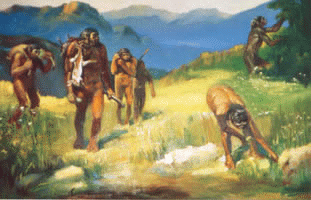 The family business is to "drive" herds of deer and contain them in particular grazing areas, kinda like cowboys do with cattle. Your family drives deer herds through the forest by making powerful knock sounds with large sticks. When your family spreads out a good distance apart, and forms a drive-line, they can drive the deer in the direction they need them to go, using coordinated knock sounds. The deer move away from those sounds. It scares them. The family business is to "drive" herds of deer and contain them in particular grazing areas, kinda like cowboys do with cattle. Your family drives deer herds through the forest by making powerful knock sounds with large sticks. When your family spreads out a good distance apart, and forms a drive-line, they can drive the deer in the direction they need them to go, using coordinated knock sounds. The deer move away from those sounds. It scares them.
Sometimes when there's no good sticks handy you will clack large rocks together.
You can find deer that way too. As your family pushes a drive line through a valley you will hear the deer breaking brush as they dash away through the forest. Deer usually don't run very far. Once you hear deer breaking brush, your family can zero in on them and push them in a desired direction. Your family can even push them toward you so you can grab one.
Chasing down deer is totally unecessary. Working as a team your family can push deer through a bottle-neck in the terrain. Before they do that, you can position yourself at a pinch-point among large obstructions. Your family can drive the deer through that pinch-point where they will pass by within a few feet of where you will hide. From that spot you can literally reach out and grab the leg of a deer as it trots by.
Once you've got a deer by the leg and you snap that leg ... it's all over for the deer. It isn't going to get away.
The more rugged or dense the terrain is, the more hiding places there will be and the more pinch-points there will be for ambusing deer.
When the fresh forage for a deer herd runs out in a given area, you will need to drive the deer to new grazing areas, but you need to drive them in a particular direction, otherwise they might wander too far away from your prefered areas.
Your family directs them to the areas with the best forage and where they will be easy to check on occassionally.
Once the deer have settled down and feel safe in a new fresh grazing area you are then free to go for more long walks at night with your family to find more small herds to drive to convenient grazing areas along your circuit.
You go for long walks at night trolling for more deer that can be driven into particular valleys and tributaries so they will be more accessible to you when you need them in winter.
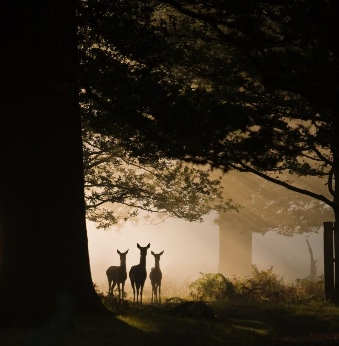 You want to the deer to stick around and graze on the most fattening nuts, berries and plants. You know where those areas are and know how to keep the deer contained in those areas. You want to the deer to stick around and graze on the most fattening nuts, berries and plants. You know where those areas are and know how to keep the deer contained in those areas.
Life is good as long as you can keep the peace in your area. You need to keep the peace so the deer feel safe and they stick around.
Deer are you most important protein source, but not your only protein source. As you shephard the deer and contain them in particular areas you have time to look for
snakes, small mammals, and crayfish as you forage for various plants, berries, nuts, etc.
All the families like yours prefer to spend down-time in quiet, wind-sheltered parts of the terrain. Of particular value are quiet places surrounded by difficult rocky terrain or impenetrable brush or swamps, but not far from where the deer will graze at dusk. Your family can move from one of those strategic places to the next whenever necessary without crowding other families like yours.
There's not many furry caveman families like yours out there, so all the families have lots of acreage all to themselves. You never have to defend yourself from attacks by other furry caveman families. War does not exist in your society, because there's plenty of deer to go around.
You really don't like strong cold winds, so if you're in terrain with no hills or creek gullies to provide shelter from strong cold winds, you'll look for the densest clumps of trees or brush to hunker down in until the strong cold winds blow through. Strong cold winds will disrupt your furry insulation layer. That costs you energy in the form of calories. Your energy calories are like money to you. You can't spend them frivolously. You need to save as much as possible in order to support you through the off season.
Difficult terrain and/or impenetrable brush provides the most security to the family. It provides excellent cover and limitless places to hide. Your family feels most safe in quiet places that can only be approached from one direction but have numerous shrouded escape routes. In those quiet places you can hear any little green men approaching, and you can flee without being detected.
You observe
the little green men from a distance as they travel over the land. Occasionally
some littel green men stop in your area and disturb the peace and scare the deer away -- the deer your family spent so much time driving into that area. You don't like that.
 The little green men are less than half your size, and seem to have only
a fraction of your strength, but they have many technologies and weapons. The little green men are less than half your size, and seem to have only
a fraction of your strength, but they have many technologies and weapons.
Little green men cannot travel very fast on foot, especially
off the trails. You don't worry about them chasing you down, but you still worry about them seeing you. You worry about that a lot. You know that if a little green man sees you he might bring back other little green men to get a look at you, and possibly shoot you with rayguns. You don't want that.
Compared to you they are so small that even a group them would be no match for you. You could kick
them away from like footballs. So you don't worry about them overpowering you, but you never want them to approach or spot you out in the open, because you do fear those
rayguns.
Little green men travel around in spacecraft. Their spacecrafts
move fast but they cannot penetrate into the woods very far.
If you merely keep away from their
established pathways in daylight they won't spot you. They usually fly through the forest quickly,
but occasionally some spacecraft land in your little valley. It's nothing to worry about most of time because they only stick around for a few hours ... most of the time.
Sometimes little green men
camp there for a few days. Sometimes some of them come to hunt
deer with their rayguns. You don't like that because those are your deer.
The little green men are accompanied by little green dogs somtimes. Some of those dogs can run as fast as you, and they always bark like crazy when they see you, so you are very afraid of dogs. They will even bark if they merely
hear movement in the brush in the distance. For those reasons you need to keep a greater distance
from little green men if they have dogs with them.
It is never necessary to directly confront little green men in order to protect
your turf. The same cannot be said for their dogs though. You might
need to kill one if it chases you. Or you might have to flee quickly if
one barks at you while you are trying to sneak up to their camp at night. Indeed, you do not like dogs.
You get very concerned about large groups of little green men camped in your area, because it's impossible to keep tabs on all of them if there are too many in your valley. By contrast, you are not worried at all when there is only one or two
of them waddling down a trail, especially if they're not carrying ray
guns. They pass through and you usually never see them again.
Thankfully, little green men almost
never stick around for long in your area. If they do stop in your forest, within a few hours or days they will always pack up
and fly away in their spacecraft. If you simply avoid them for a few hours or days, they will leave on their own volition.
You know you should never kill a little green man. You don't want to injure
one either, because you know what happens. You've seen it happen along the highway. When a little green man is hurt or in distress,
a loud swarm of little green men will come to help, which is the opposite
of what you want. You want them to leave and never come back. You don't want them to scare even more of the deer away.
If some little green men are camped in your area, and they are scaring the deer away, then you have to play tough. You have to spook them after dark. You need to make them feel uncomfortable in that area, but without letting them see you. If you can spook them from a distance, and make them feel too uncomfortable to sleep there, they will pack up and leave right away, or at least the next morning.
You want those little green men to shove off and go home and tell all
the other friends to avoid your area. Your people have been doing that for generations and it works well.
***
Because the little green men are you biggest threat, you need to know about them and how they operate. You watch them whenever you can, to learn their ways. After observing many camps of little green men over the years you've noticed some interesting things. They have
trouble seeing in the dark. That's a good thing for you because your kind has no problem seeing in the dark. You are made for stalking deer in forests at night. Also, you do everything pretty quietly, whereas the little green men make noise almost constantly, especially when they fly around in their spacecraft..
Their campfires and flashlights allow you to keep track of
them after dark, so you never worry about bumping into one by accident. They don't go into the woods at all after dark. Their vision handicap, combined with their physical shortcomings
are very comforting to you and your family. It means you can approach
their camps at night to inspect the camp and see if they are hunting deer. Even if they hear you moving
near their camp and they react, you are safe as long as you can run away into thick brush nearby.
You might watch them for hours, as you try to assess what they are
doing. You need to know if your family needs to evacuate
the area. If there are many of them coming into the area to hunt deer, then it is simply too risky to hang around. For that reason you need to keep tabs on them, and monitor their camp whenever you see them gathering. You need to know how much of a threat your family might face
from a gathering of little green men.
At times of year when you really need to protect your family's food
supply, you always pay closer attention to them. Sometimes you want the little green men to leave your area right away. In those situations you are more willing to scare and intimidate them, but not
through direct, open confrontation. You can throw rocks at them
from a distance. You can topple dead trees. You can also make intimidating sounds by snapping heavy
branches. You can demonstrate how big and strong you are by stepping loudly through
brush once they are inside their tents trying to sleep. Most of the time that
works. It scares the little green men into leaving the area sooner than they would otherwise.
Occasionally
other families like yours travel through your area and make contact with you and your family.
Your lifestyle doesn't provide
many social opportunities so you are always happy and
eager to greet these other families when they come looking around for
you. You are happy to have friendly visitors.
If a neighboring family is shadowing a large herd of transient deer or
elk into your area, you may hear the family as they knock back and forth to each other, to signal their positions
and keep the deer/elk moving in the prefered direction. When you and your family
notices the familiar knocking sounds of a deer drive, you all go and join them in the hunt. You enjoy
the social contact on those occasions. That is your world and your society. Except for the weather, your world is nicely stable and predictable. It is civilized in its own special way, and it has been that way for thousands of years.
***
Then one night something very odd happens. You hear knocking in the
woods. It sounds just like what your family does in the woods. The knocking sounds are irresistible to you. You feel compelled to investigate
the sounds because you associate the sounds with social interaction.
You knock back to announce yourself. You assume the knock-makers are others
like you.
As you get closer you spot some small upright figures moving slowly down a trail in
the dark. You've never seen little green men in the woods at night, especially with
no lights on, so you still assume they must be others just like you. Perhaps
just juveniles, because they all seem kinda small.
When you get closer you become more concerned about their identities. They
are all dark colored, but there is something unusual about their
movements. You don't see any artificial lights (which the little
green men always have with them in the woods at night) so you are
confused, but still very, very curious.
These mysterious figures are walking down a trail and knocking just like
you do to drive deer. You are compelled to follow them and get close enough to see exactly
what they are, and what they are up to.
They walk for a while, then stop and look around. You stop whenever they stop so they won't hear your footsteps as you shadow them. You continue to parallel
them as they
move along the main trail. You follow them all the way back to their camp.
It turns
out to be a camp full of little green men.
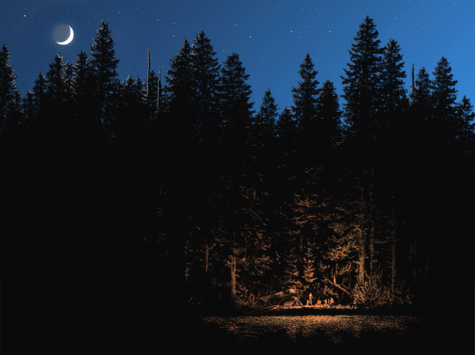 Now you really want to know what they are up to,
so you continue to watch them from a safe distance until they go to sleep in their tents. You
see boxes and coolers in their camp, so you know there's food, but you don't know if they brought food, or if they are collecting food. You want to look in those boxes to find out if they are collecting your food. The only way
you can do that safely is by waiting until they are all asleep. So you depart and then
return in the wee hours of the morning when you can hear them snoring
and breathing as they sleep. Now you really want to know what they are up to,
so you continue to watch them from a safe distance until they go to sleep in their tents. You
see boxes and coolers in their camp, so you know there's food, but you don't know if they brought food, or if they are collecting food. You want to look in those boxes to find out if they are collecting your food. The only way
you can do that safely is by waiting until they are all asleep. So you depart and then
return in the wee hours of the morning when you can hear them snoring
and breathing as they sleep.
Before sneaking into their camp, you first you need to determine if they have any dogs with them.
That's easy. Just snap a few small branches near their camp. If that doesn't cause an eruption of barking or growling, then there's no dogs present.
Then you make some obvious stepping sounds through the brush to see if that gets any reaction.
To be sure that everyone is alseep, and to make double sure there are no dogs,
you throw some small rocks at the tents and even at the spacecraft. Clink ... Clink ... but no barking or grumbling inside the tents,
just snoring ... Now you definitely know there are no dogs in the camp, and you know everyone is sleeping. Now you can sneak into the camp with no worries.
Little green men do not handle the cold very well. You know that because
of the way they dress and the way they huddle around big campfires. You also know that they get inside warm bags when they go to sleep. They are well bundled in those tents, so they make plenty of noise before they
emerge from their tents. That gives you plenty of time to step into the trees and shadows before one can
emerge from a tent.
If a little green man does wake up in the middle of the night,
it is even more feeble and handicapped than it is in the daytime. When emerging from
a deep sleep they can't quickly leap up and out of their tents. Their bodies take a little while to start moving again. Dogs, by contrast, can jump up instantly and start barking furiously if
they hear a prowling animal outside.
After circling the camp for about 15 minutes, to make sure all the little
green men are asleep, you walk into their camp. You open their coolers to look inside.
You also peek into the back of any open bed pickup spacecraft, to see
if there's any deer carcasses in there.
In one part of their camp the ground is muddy. You carefully avoid stepping
in the mud so you will not leave any footprints for them to find
the next morning. Little green men pay lots of attention
to animal tracks, so you know they would notice your tracks too. If the ground is wet but the temperature drops below freezing
at night, you will wait til the ground is frozen so you can walk around freely without leaving any tracks behind in the mud.
In the camp of little green men you don't find any deer carcasses or gut
piles, so you're not sure what these little green men are up to. In order
to figure that out you'll need to come back each to watch them more, and you'll do it in a particular pattern. You'll
come and watch the camp from a distance for a little while right after
dark because you want to see if they are preparing to walk
out from the camp in the dark, as they did the night before. You might
shadow them or you may simply leave and return in the
wee hours of the morning to see if they've
brought back anything gathered from the woods.
This chapter was unfinished, because we talk more about the little green man analogy during the expeditons.
|